
Artificial Intelligence (AI) has undoubtedly become the most popular emerging technology this decade. From ChatGPT and Google Gemini to self-driving cars and AI-enhanced surgery, every aspect of industrial life and personal touches globally is increasingly being touched by AI. It is moving at breakneck speed, but several myths attached to it only add to its bewildering nature. The fact is that AI cannot be magic or an alternative to human intelligence. Instead, it is an amazing tool used for elevating productivity by automating menial tasks and serving humans in making judgments.
One of the most commonly held myths about AI is that it will replace all human jobs. In truth, what is likely to happen is that AI will replace monotonous jobs while creating new career tracks in developing AI, cybersecurity, digital marketing, healthcare, robotics, and data science. According to the World Economic Forum, millions of new jobs will be created through AI, while already-existing jobs will change the course of action.
Another folklore is that AI thinks and feels like a human. The real thing is that AI does not have emotions, consciousness, or even a point of view. Responses from AI are generated by pattern recognition on data and predicting the best probable outcome based on past events. Human creativity, for instance, empathy, ethics, and critical thinking cannot be replicated.
Many believe that AI is 100% accurate. In fact, AI systems can also be resulted in giving wrong or misleading information when trained on data that is either biased or outdated. Therefore, human verification becomes important, especially in healthcare, finance, legal services, and education.
Most businesses consider AI a prospect for large enterprises. But the reality is that there are several affordable AI tools now available for startups and small businesses. From customer support to content creation, SEO, digital advertising, lead generation,
| Myth | Reality |
| AI will replace humans completely. | AI assists humans by automating repetitive tasks. |
| AI is always correct. | AI requires human verification and quality control. |
| AI thinks like humans. | AI recognizes patterns but has no emotions or consciousness. |
| AI is only for big companies. | Businesses of all sizes can leverage AI solutions. |
| AI is dangerous by itself. | AI depends on how humans design and use it responsibly. |
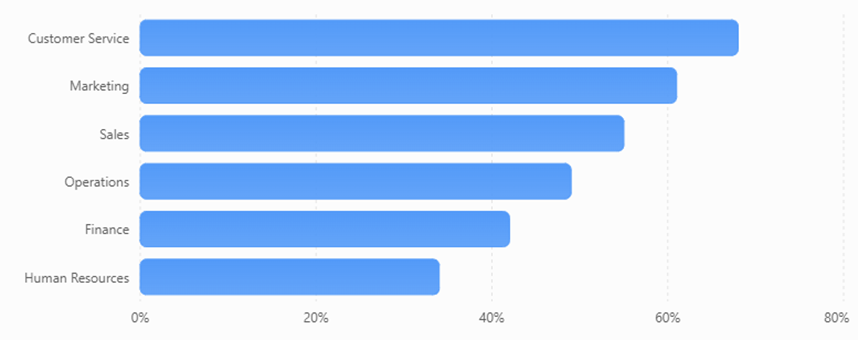
AI Adoption by Businesses (Estimated Global Usage)
Business AI adoption by function
Illustrative global estimates showing common AI adoption across business functions.
Key AI Metrics
📈 Recent industry surveys indicate that 78% of organizations use AI in at least one business function.
💼 According to a PwC estimate, AI will contribute more than $15 trillion to the global economy by 2030.
Companies that initiate AI-driven automation often see productivity gains of between 20% and 40%, depending on the sector and how the technology is implemented.
Generative AI has dramatically reduced content creation time, time to respond to customer support inquiries, and effort in software development.
AI-enhanced SEO and marketing analytics enable businesses to make faster, data-driven decisions and optimize campaign performance. It is not a myth but a reality that is already changing business operations and how people work. Moreover, AI is not a magical solution to be placed alongside human intelligence. The most successful organizations place AI atop a layer of human intelligence, creativity, ethical judgment, and strategic insight. Instead of fearing AI, they should turn their attention to learning its responsible use to boost productivity, enhance customer experience and ignite innovation. The future does not belong to AI but to those who can blend seamlessly with it.