
Google’s search algorithm continues to evolve, but the fundamentals of effective SEO are remarkably consistent. According to insights gleaned from 131 SEO professionals, search intent is the most influential ranking factor, while high-quality backlinks support the contention that mass-produced, scaled AI content can no longer outshine original research and genuinely useful content.
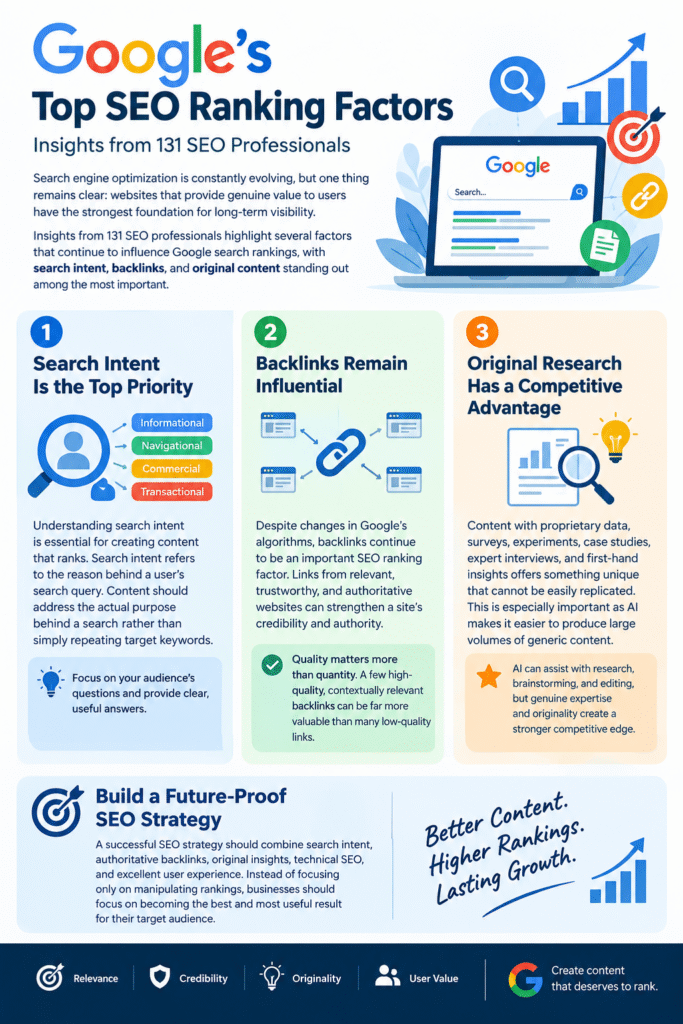
Search Intent Takes the Top Spot
The strongest signal, in the view of SEOs, is search intent-what the user really wants when he or she writes a query on Google.
Generally, content that answers a user’s question, solves a problem, or meets some other compelling need has a better chance of succeeding. More than targeting keywords, content should be created around the purpose of the search, whether the intent is informational, commercial, navigational, or transactional.
That elevates strategy to an audience analysis stage and means that, at first, SEO will involve figuring out what type of content Google considers relevant for a query.
Backlinks Still Matter
Inasmuch as SEO is ever-changing, backlinks remain one of the continued best ranking factors. A link from a well-reputed, relevant, and authoritative website is one of the best signals to show Google that a page has value and credibility.
Not every link will be automatically valuable, and that should not be the end goal of trying to get backlinks. Quantity does not reign supreme in this case; quality is far more important. A few relevant links from trusted websites may well confer more value than many bad or unrelated links.
The company’s digital PR efforts, embryonic original research, contributed expert opinion, or resources and content that have intrinsic value and appeal can help it acquire top-level backlinks naturally.
Original Research Beats Scaled AI Content
Another crucial takeaway is the increasing value of original research and first-hand insights. For instance, only original content based on data, surveys, experiments, case studies, expert opinions, or proprietary findings can distinguish such content from equally generic information available online.
While AI may assist in conducting research, ideation, editing, and even the act of writing, let us not forget that mass production of AI-generated articles will not gain any edge and be unsustainable. Search engines are increasingly rewarding content that reveals true value, expertise, and originality in its usefulness.
The Future of SEO
Effective SEO increasingly moves away from the shortcuts of past techniques and toward a laser-focus on user-centric authority, originality, and credibility.
Businesses need to invest in understanding search intent, creating genuinely helpful resources, acquiring high-quality backlinks, and crafting original takes. AI can help with that, but only when it complements human expertise rather than substituting it. The SEO rule is quite simple: make the content rankable by giving something valuable to people searching for it.
What is the most important Google SEO ranking factor?
Search intent, one of the most integral factors, focuses primarily on whether content fulfills users’ real needs.
Are backlinks still important for SEO?
Yes, relevant, quality backlinks are still important for establishing a site’s authority and proving credibility.
Is AI-generated content bad for SEO?
It is not bad per se; what matters is whether it can deliver real value, be accurate, demonstrate expertise, be original, and provide a good user experience on the page.
Why is original research important for SEO?
Original research yields information unique to the site conducting it that cannot be replicated by other websites; therefore, it creates a chance for that site to potentially gain citations, shares, and backlinks.
How can a business rank higher on Google?
Business should satisfy search intent, create quality, original content, gain authority in backlinks, improve technical SEO, and outdo competitors in the user experience.