
An Educational Guide by DKS Digitech | Artificial Intelligence | Business Automation | Digital Transformation
Artificial Intelligence (AI) is changing the way businesses work, communicate with customers and manage their daily activities. From automating routine tasks to improving customer experiences, AI is becoming an important part of modern business operations.
One of the most interesting developments in this field is AI Agent Technology.
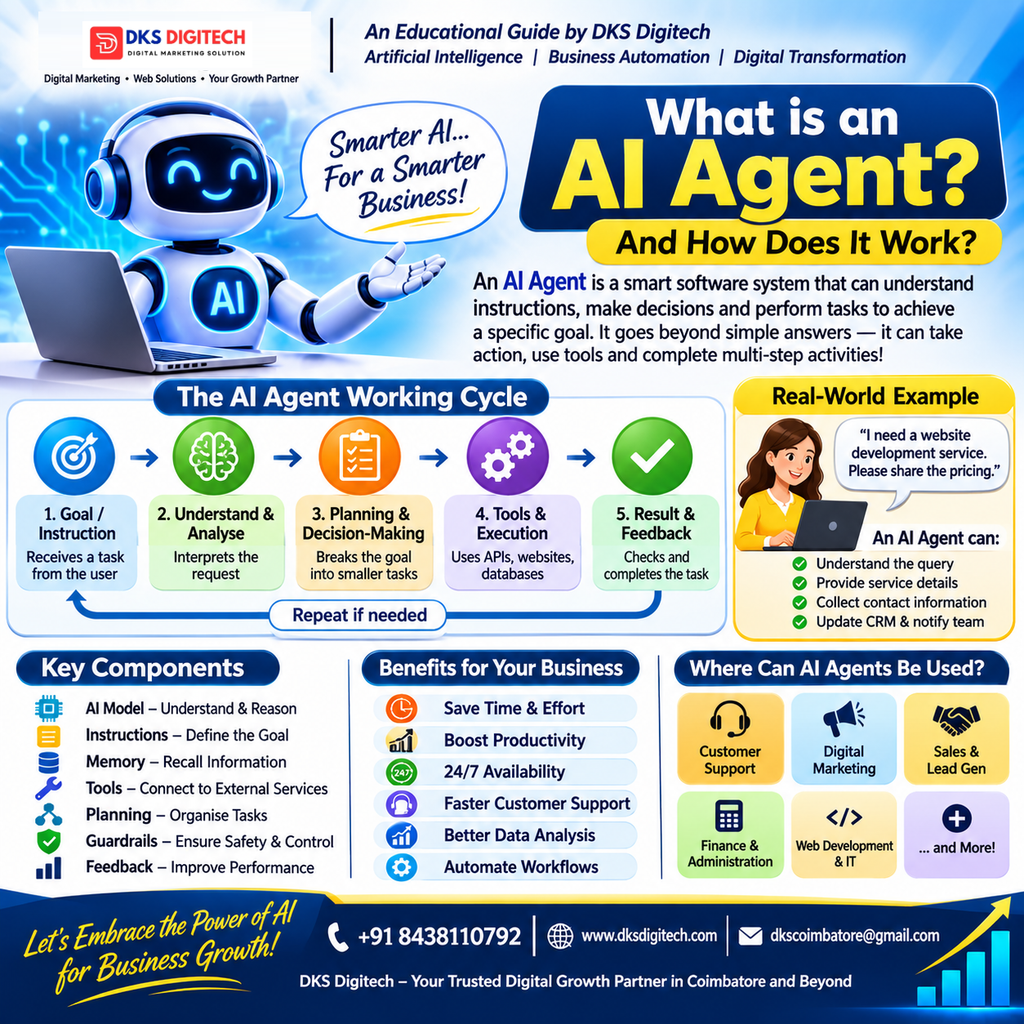
Until recently, many people used AI mainly to ask questions, generate content or find information. But AI has evolved beyond these basic capabilities. Today’s AI-powered agents can understand instructions, analyse information, make decisions, use different tools and carry out tasks with minimal human involvement.
Think about a system that can understand a customer’s enquiry, collect the required details, update business records and notify the sales team automatically. This is just one example of how AI agents can make everyday business activities easier.
Whether it is digital marketing, customer support, sales, business administration or data analysis, AI agents are opening up new opportunities for businesses of all sizes.
So, let’s explore what AI agents are, how they work, their main components and how businesses can make the most of this emerging technology.
1. What Is an AI Agent?
An AI Agent (Artificial Intelligence Agent) is a smart software system that can understand instructions, analyse information, make decisions and perform actions to achieve a specific goal.
Unlike traditional software, which generally follows a fixed set of programmed instructions, an AI agent can understand different situations and decide what steps are needed to complete a task.
In simple terms, an AI agent doesn’t just provide information. It can also take action based on what it understands.
Let’s understand with a real-world example.
Imagine a customer visits your company’s website and asks:
“I’m looking for a website development service. Could you share your pricing and package details?”
A basic chatbot might simply display a standard response with service information.
But an AI-powered agent, when connected to the necessary business tools, can do much more:
- Understand what the customer is looking for.
- Identify the specific service requested.
- Retrieve the relevant service and pricing information.
- Share suitable website development packages.
- Ask for the customer’s name and contact details.
- Save the enquiry in the company’s CRM system.
- Notify the sales team so they can follow up.
All these activities can happen through one connected workflow, without requiring an employee to handle every individual step.
This is where AI agents become valuable. They help businesses move beyond simple automated responses and towards intelligent task execution.
2. How Does an AI Agent Work?
Have you ever wondered how an AI agent understands a request and decides what to do next?
An AI agent works by combining artificial intelligence, data, reasoning capabilities, connected tools and automated actions.
When someone gives an instruction, the agent first understands the requirement. It then identifies the steps needed to achieve the goal, selects suitable tools and carries out the required activities.
Once the task is completed, it reviews the outcome and determines whether anything else needs to be done.
The AI Agent Working Cycle
1. Goal / Instruction
Receives a task or instruction from the user.
2. Understand & Analyse
Interprets the request and identifies the information required.
3. Planning & Decision-Making
Breaks the main objective into smaller, manageable tasks.
4. Tools & Execution
Uses connected applications, APIs, websites, databases and software to perform the activities.
5. Result & Feedback
Reviews the outcome, identifies missing information and adjusts its approach when necessary.
This is a simplified representation of how an AI agent operates. Depending on the task, an agent may repeat these steps until it achieves the intended result.
Step-by-Step Explanation
Step 1: Receiving Instructions
Every AI agent starts with a goal or instruction. This could come from a website enquiry, a user prompt, a voice command, a scheduled task or another connected application.
For example:
“Find 20 potential customers who may be interested in website development services.”
The agent receives this instruction and identifies the expected outcome.
Step 2: Understanding the Request
The AI model analyses the instruction, understands the context and identifies what information is needed.
In this example, it may identify the relevant industries, business categories and customer requirements.
Step 3: Planning the Activities
Instead of trying to complete everything at once, the agent breaks the task into smaller steps.
It may plan to research relevant businesses, identify suitable prospects, collect publicly available business information and organize the findings into a structured list.
Step 4: Taking Action
Now comes the execution stage.
The AI agent uses its connected tools, such as web search, APIs, CRM platforms, spreadsheets, email applications or databases, to perform the assigned activities.
The actual actions depend on the tools available and the permissions granted to the agent.
Step 5: Reviewing the Results
Once the activities are completed, the agent checks whether the expected outcome has been achieved.
If some information is missing, it may search again, try another available approach or ask for human assistance.
This continuous process of understanding, reasoning and taking action is an important part of modern AI agent technology.
3. What Are the Main Components of an AI Agent?
An AI agent is much more than a single AI model. Several important components work together to help it understand instructions, make decisions and complete tasks.
Understanding these components makes it easier to see how AI agents operate in real business environments.
| Component | What it does |
| AI Model | Understands instructions and supports reasoning |
| Instructions | Defines the agent’s role, goals and responsibilities |
| Memory | Retains relevant context or stored information |
| Tools | Connects with external applications and services |
| Planning | Organizes tasks and selects actions |
| Guardrails | Controls permissions, safety and limitations |
| Feedback | Evaluates results and helps improve performance |
For example, an AI model may understand a customer’s question, but it needs access to a company’s product database to retrieve accurate pricing. It also needs permission to update a CRM if it is expected to record the enquiry.
4. What Are the Different Types of AI Agents?
AI agents can be classified according to their capabilities, architecture and level of autonomy.
1. Simple Reflex Agents
These agents respond to specific inputs using predefined rules.
Example: A system that automatically sends a welcome message when someone submits a website enquiry.
2. Model-Based Agents
These agents maintain an internal representation of the situation and use available information to decide what to do.
Example: A customer support agent that considers previous conversations before responding.
3. Goal-Based Agents
These agents work towards a specific objective and select actions that help achieve it.
Example: An agent that researches potential customers and prepares a qualified sales prospect list.
4. Utility-Based Agents
These agents compare possible outcomes and select an action based on a defined measure of value or benefit.
Example: An advertising optimization agent that compares campaign performance and recommends budget adjustments.
5. Learning Agents
These agents use feedback or learning mechanisms to improve their performance over time.
Example: A recommendation system that adapts suggestions based on customer interactions.
These are useful conceptual categories; modern AI agents can combine several of these approaches.
5. What Is the Difference Between an AI Chatbot and an AI Agent?
Many people think AI chatbots and AI agents are the same. However, there is an important difference.
| AI Chatbot | AI Agent |
| Primarily responds to questions | Works towards a defined goal |
| Provides information | Can perform actions |
| Often follows predefined conversation flows | Can plan and adapt its workflow |
| Usually waits for user input | Can work through multiple steps |
| Limited integrations in basic versions | Can connect to multiple tools |
| Usually conversational | Can execute complete workflows |
Practical example:
A traditional chatbot answers: “Our website development service starts with a consultation.”
An AI agent can understand the enquiry, retrieve the relevant service information, collect customer details, create a CRM entry and notify the sales team, if it has the required integrations and permissions.
A chatbot can also become agentic when it is connected to tools and given the ability to execute tasks.
OpenAI Developers+1
Web Development & IT
Analyse code, identify potential issues, prepare test cases, document software and support development workflows.
7. How Can AI Agents Help Digital Marketing Companies?
For digital marketing agencies, AI agents offer opportunities to automate repetitive work and improve productivity.
Here are some practical examples relevant to DKS Digitech.
SEO Agent
- Research industry-specific keywords.
- Analyse website SEO performance.
- Identify missing metadata and technical SEO issues.
- Suggest internal linking opportunities.
- Prepare SEO audit reports.
- Monitor keyword performance.
Social Media Agent
- Research trending topics.
- Generate social media content ideas.
- Prepare captions and hashtags.
- Create a content calendar.
- Analyse social media engagement.
- Prepare monthly performance reports.
PPC Advertising Agent
- Analyse Google Ads and Meta Ads performance.
- Monitor clicks, conversions and cost per lead.
- Identify underperforming campaigns.
- Suggest keyword and audience improvements.
- Recommend budget adjustments for human approval.
Lead Generation Agent
- Research relevant business prospects.
- Identify potential customer requirements.
- Organise prospect information.
- Prepare personalised outreach drafts.
- Update CRM records and schedule follow-ups with permission.
Website Analysis Agent
- Review website content.
- Identify broken links and technical issues.
- Analyse page performance data.
- Recommend website improvements.
- Generate periodic website audit reports.
These applications require appropriate data access, integrations and safeguards. AI recommendations should be checked before important changes are made.
8. What Technologies Are Used to Build AI Agents?
AI agents are developed using different technologies and platforms. Some of the commonly used technologies include:
| Technology | Purpose |
| Large Language Models (LLMs) | Understand language and perform reasoning |
| Machine Learning | Identify patterns and make predictions |
| Natural Language Processing | Understand human communication |
| APIs | Connect with external applications |
| RAG (Retrieval-Augmented Generation) | Retrieve information from knowledge sources |
| Vector Databases | Store and retrieve information based on meaning |
| Automation Platforms | Connect and automate business workflows |
| Python & JavaScript | Develop AI applications and integrations |
Some popular AI platforms and frameworks include:
- OpenAI – AI models and agent development tools.
- Google Gemini – AI models and development capabilities.
- Anthropic Claude – AI models and agent-oriented workflows.
- Lang Chain – Framework for building AI-powered applications.
- n8n – Workflow automation and AI integrations.
- Microsoft Copilot Studio – Building AI agents for business applications.
9. What Are the Advantages of AI Agents?
Implementing AI agents can provide several business benefits.
- Time Savings: Automates repetitive activities and reduces manual work.
- Improved Productivity: Helps employees concentrate on important business activities.
- 24/7 Availability: Can handle assigned tasks outside regular working hours.
- Faster Responses: Supports quicker customer communication.
- Better Data Analysis: Helps process large amounts of information.
- Workflow Automation: Connects multiple applications and business processes.
- Business Scalability: Supports growing workloads without requiring every task to be handled manually.
However, AI agents are not completely error-free. Their performance depends on the quality of data, models, tools, instructions and supervision.
10. Are There Any Risks or Limitations of AI Agents?
Although AI agents offer many benefits, businesses should understand their limitations before implementation.
- Incorrect Information: AI agents can generate inaccurate responses.
- Data Privacy: Customer and business information must be protected.
- Security Risks: Uncontrolled tool access can create security problems.
- Implementation Costs: Development, integration and maintenance require investment.
- Human Supervision: Important business decisions need appropriate human review.
- Performance Monitoring: Agents must be tested and monitored regularly.
Businesses should establish clear permissions, approval processes and security guidelines before allowing agents to perform important activities.
OpenAI+2
11. What Is the Future of AI Agents in Digital Marketing?
The future of digital marketing will increasingly involve AI-powered automation, intelligent data analysis and agent-based workflows.
Imagine a digital marketing agency where different AI agents work together:
- An SEO agent researches keywords and website performance.
- A content agent prepares articles and social media content.
- A social media agent organizes publishing activities.
- A PPC agent analyses advertising campaigns.
- A reporting agent prepares performance summaries.
A coordinating agent can manage these activities and share information between specialized agents.
This approach is known as a Multi-Agent AI System.
Instead of relying on one AI system to handle everything, businesses can use multiple specialized agents to complete different activities collaboratively.
OpenAI+1
12. How Can DKS Digitech Help Businesses in the AI Era?
At DKS Digitech, we understand that digital transformation is becoming essential for businesses that want to remain competitive.
We help businesses strengthen their digital presence through modern digital marketing and web solutions.
Our services include:
- SEO & AI-Powered SEO
- Local SEO & Google Business Profile Optimization
- AEO (Answer Engine Optimization)
- GEO (Generative Engine Optimization)
- Social Media Promotion
- Google Ads & Meta Ads
- Website Design & Development
- Website SEO Audits and Performance Analysis
AI agents are creating new possibilities for businesses. By combining AI technologies with effective digital marketing strategies, businesses can improve their online visibility, customer engagement and operational efficiency.
The future is not just about using AI. It is about using AI intelligently to achieve better business results.
Your Digital Growth Partner
Helping businesses move towards smarter digital marketing and technology-driven growth.
Call: +91 8438110792, Email: dkscoimbatore@gmail.com
Coimbatore, Tamil Nadu | Serving businesses across India and international markets.
Frequently Asked Questions (FAQs) About AI Agents
1. What is an AI agent in simple words?
An AI agent is software that understands instructions, makes decisions and performs tasks to achieve a goal.
2. Is ChatGPT an AI agent?
ChatGPT is an AI assistant. When equipped with tools and the ability to execute workflows, it can operate agentically.
3. Can AI agents work without human intervention?
Yes. They can perform authorised tasks independently, but supervision is important for sensitive activities.
4. Can AI agents generate business leads?
Yes. They can research prospects, organise lead information and support follow-up workflows.
5. Are AI agents useful for small businesses?
Yes. They can help small businesses automate customer support, marketing and administrative activities.
6. Can AI agents replace digital marketing professionals?
AI agents can automate repetitive tasks, but strategy, creativity, expertise and human judgement remain important.
7. What is the difference between AI and Agentic AI?
AI performs intelligent tasks; Agentic AI uses AI to plan and execute multi-step activities towards a goal.
8. Do AI agents require programming knowledge?
Not always. No-code automation platforms make it possible to build certain agents without extensive programming knowledge.